

ME1.01 Quiet Cooling System for Semi-Open Air Sports Simulator Bays
Sponsor: Space Alliance Technology Outreach Program (SATOP)
Student Team: Osbaldo Aviles-Espinoza, Dylan Davison, Jamal Essoufi, Jon Ramos, James Swift
Project Advisor(s): Dr. Mohammad Abdelkareem, Dr. Khosrow Ebrahimi
Faculty Instructor: Dr. Karim Muci
Design an energy-efficient and unobtrusive system to cool semi-open sports simulator bays where summer temperatures exceed 100°F. The proposed solution must ensure comfort for both players and guests without obstructing gameplay. The desired system must cool the entire bay, minimize noise, and withstand outdoor environmental conditions.
ME1.02 Soft Robotic Gripper to Handle Fruits

Sponsor: Ingram School of Engineering (ISoE)
Student Team: Dylan Lewis, Filip Bazant, Jonah Pham, Sergio Duenez
Project Advisor(s): Dr. Rick Schieni, Mr. Abhimanyu Sharotry
Faculty Instructor: Dr. Karim Muci
The project objective is to design a soft robotic gripper capable of safely handling soft fruits, using peaches as the primary test. The gripper will use soft and flexible materials so it can gently conform to the shape while maintaining a secure grip. The gripper will also work efficiently and be a reliable attachment to the UR 7e COBOT robotic arm with the potential of being useable in different robotic systems. This product will have applications in agriculture, produce retail, and any other industry related to soft foods.
ME1.03 Soft Robotic Gripper to Handle Fruits
Sponsor: Ingram School of Engineering (ISoE)
Student Team: Cristian Cisneros, Raymond Hagler, Kevin Nebo, Agustina Rojas
Project Advisor(s): Dr. Rick Schieni, Mr. Abhimanyu Sharotry
Faculty Instructor: Dr. Karim Muci
Our mission is to develop a compact, flexible, and food-safe soft robotic gripper capable of delicately manipulating fruit. The system will be designed to reliably pick up, transport, and release a variety of fruits, with a primary focus on handling peaches without causing damage.
ME1.04 Drivetrain for TXST Formula SAE Vehicle

Sponsor: Bobcat Racing
Student Team: Noah Contreras, Jasper Greenall, Ricardo Melendez Rivera, Nicholas Sarbeck
Project Advisor(s): Dr. Sevan Gonezen
Faculty Instructor: Dr. Karim Muci
The 2026 Formula SAE vehicle requires a high-performance Final Drive System (FDS) to effectively transfer power from the Yamaha FZ6 engine to the rear wheels. We have been tasked by Bobcat Racing to design and develop a reliable, lightweight and Formula SAE rule compliant FDS for efficient power delivery. The outlined future vehicle plan is to use this subsystem as a structural member of the vehicle. By following the concept generation stage of the product development process we will deliver a selected concept for the Final Drive System (FDS) as we continue into testing and manufacturing in D2 next semester.
ME1.05 Chip Handling System
Sponsor: Ingram School of Engineering (ISoE)
Student Team: Preston Wilder, Kayden Cuellar, Peyton Homann, Joey Townsend
Project Advisor(s): Dr. James D. Banks, Dr. Shuvodeep De
Faculty Instructor: Dr. Karim Muci
An efficient chip handling system for a CNC machine that ensures chip removal and proper sorting when switching materials. The chip handling system will reduce cross-contamination, decrease downtime during material changes, and improve overall chip removal efficiency. The system will be designed for the HASS VF-2 CNC mill; however, our team will aim to make it compatible with any CNC machine in need of a chip handling system.
ME1.06 Sit-to-Stand Trainer (STS-T)
Sponsor: Department of Physical Therapy
Student Team: Alexandra Gilmore, Fatima Hassan, Grace Schmitt, Isabela Willis
Project Advisor(s): Mr. Bradley Safranske
Faculty Instructor: Dr. Karim Muci
The objective of this project is to design and develop a safe, adjustable Sit-to-Stand Trainer (STS-T) that helps patients regain functional independence. Unlike standard lifts, our device actively engages the full kinetic chain of muscles needed to transition from sitting to standing. The device features a portable design that is engineered for use in clinical settings like physical therapy centers. By providing controlled assistance and integrated safety functions, the STS-T offers a durable solution for those recovering from surgery or managing balance and strength deficits.
ME1.07 Sit-to-Stand Training Device
Sponsor: Department of Physical Therapy
Student Team: Mathew Mendoza, Cameron Sumner, Ethan Mauricio Aguilar, Angel Gonzalez
Project Advisor(s): Dr. Bingyang Zhang
Faculty Instructor: Dr. Karim Muci
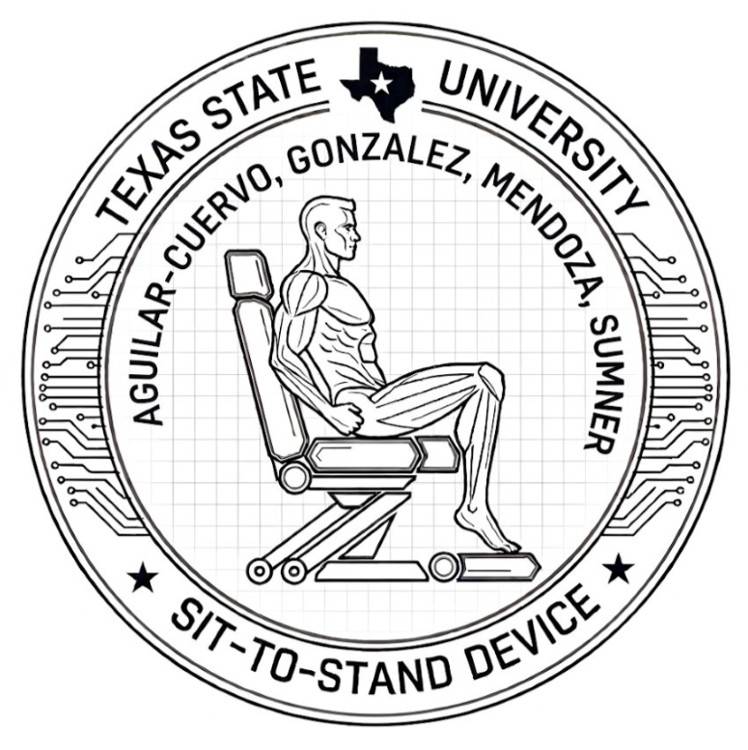
It is a device that assists rehabilitation and is engineered to support patients safely through the fundamental biomechanics of the sit-to-stand transition (STS). Getting up from a seated position requires coordinated motion across a person’s ankles, knees, hips, and torso. This motion must be stable enough and overcome gravitational and inertial forces while maintaining balance, which can be very difficult for individuals who are physically challenged due to weaknesses, poor posture control, and pain. The proposed trainer is designed to reduce all these risks by only applying a certain amount of assistance depending on the physical therapist’s expertise.